

We’ve all heard the advice: “Set firm boundaries.” It sounds straightforward when you’re calm, reading an inspirational quote, or advising a friend. But what happens
Why one word was never enough
English gives us one word for love. With it, we say we love our mothers, our partners, our dogs, a good meal, the feeling of Friday afternoon. The same four letters, carrying all of it.
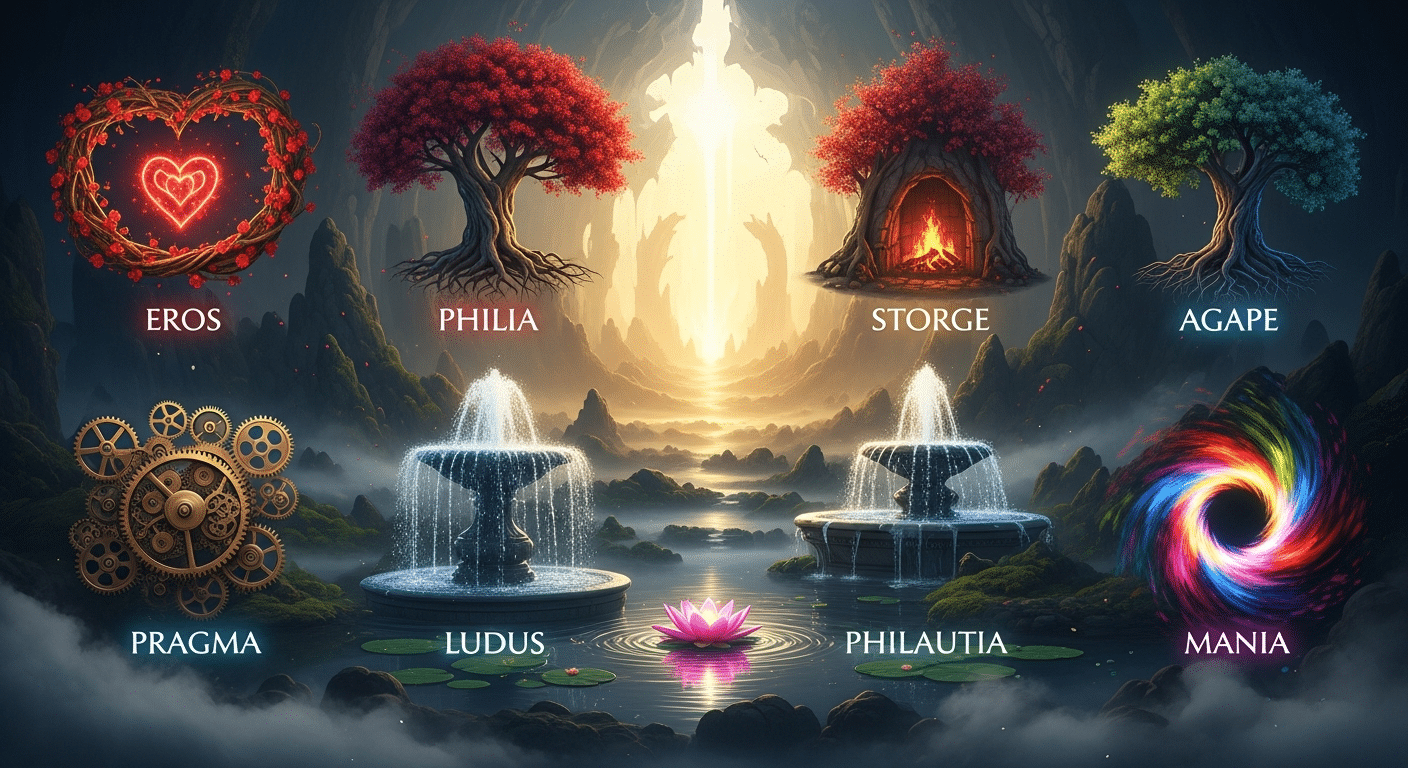
The ancient Greeks thought this was insufficient. They developed eight distinct words for eight distinct experiences, each capturing something the others couldn’t. Reading them together is like putting on glasses you didn’t know you needed.
“We use one word for love the way we might use one color for an entire painting. The Greeks painted with a full palette.”
Eros is the one we know best — passionate, electric, tinged with longing and loss. The love that overwhelms reason. Plato described it as a kind of divine madness, a remembering of something beautiful the soul knew before it came to live in a body. Eros is what drives the first act of every love story. It is also what makes the early loss of it so disorienting.
Philia is friendship love — the affection between people who have shared time and honesty and chosen, over years, to remain. Aristotle considered it one of the highest goods a person could have. Not the explosive entrance of Eros, but the accumulation of small trusts. When people say their partner is their best friend, they are describing Philia living inside their relationship. It is what usually survives when the Eros has stabilized.
Storge is the love that doesn’t require earning or explanation — the love of family, the love that simply exists because it has always existed. It has a different quality than the others: less chosen, more given. It can coexist with complicated feelings. A person can feel Storge for a parent they have a difficult relationship with. The love and the complexity are not mutually exclusive.
Agape is the widest form — universal, unconditional, asking nothing in return. It is the love described in religious traditions as the love of the divine for humanity. In secular terms, it manifests as genuine care for strangers, the impulse toward justice, the willingness to help someone who cannot help you back. It is the love that turns outward rather than inward.
“Pragma is the love most people are actually living in — and the least likely to be written into a song.”
Pragma is the love that has endured time. The settled, comfortable, decided love of two people who have built a life. It is less feeling and more architecture. Less emotion and more commitment. When people say they ‘grew’ to love someone, they are describing Pragma — a love assembled from shared history rather than struck by lightning. It is enormously underrated.
Ludus is the playful kind — the flirtatious exchange, the banter, the delight in the game of early courtship. It is love as play, love as lightness. Relationships that have lost all Ludus have often lost something real, even if they’ve kept everything else.
Philautia is self-love — the whole conversation from Blog 03, compressed into a single word. The Greeks considered it essential. Not narcissism, but the healthy foundation that makes all other love possible.
And Mania is the shadow form — obsessive, consuming, unbalanced. Love that destabilizes rather than supports. The Greeks named it to acknowledge it, because pretending it doesn’t exist doesn’t make people any less likely to experience it.
When you say ‘I love you,’ consider which of these eight you mean. Perhaps all of them, in different proportions on different days. Perhaps that’s exactly right.
Adam Stuart Hopkins
The Soul’s Truth
We’ve all heard the advice: “Set firm boundaries.” It sounds straightforward when you’re calm, reading an inspirational quote, or advising a friend. But what happens

What calls to you when the world finally goes quiet? Not the heavy silence of emptiness, but the deep, resonant stillness that exists just past

When you stand at the edge of a vessel and look down, you see a churning trail of white foam cutting through the deep, blue

Imagine walking into a room filled with endless mirrors. At first, it seems overwhelming. Every direction reveals another version of the same image stretching infinitely